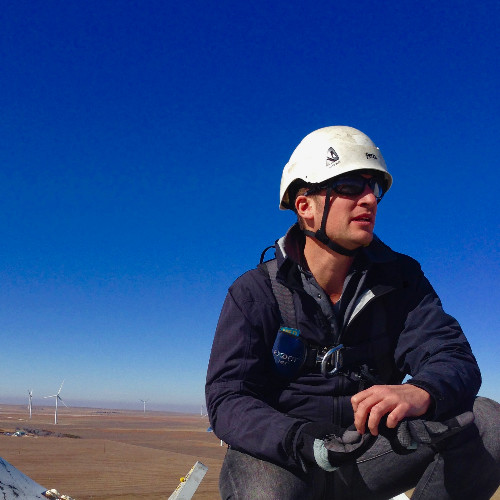
RAAW: Rotor Aerodynamics, Aeroelastics, and Wake
Project Overview
The Rotor Aerodynamics, Aeroelastics, and Wake (RAAW) experiment is a collaboration between NREL and GE Vernova to better understand the physics governing wind turbine wake generation, evolution, and recovery. As Principal Investigator, I lead this $8M+ project combining highly-instrumented commercial turbines with advanced remote sensing to connect blade loading, structural dynamics, and wake behavior.
Through partnership with GE Vernova, RAAW benefited from access to:
- Industry experts on the design, control, and operation of utility scale wind turbines
- Production turbine control systems and operational setpoints
- Validated aeroelastic models for multi-physics simulation and benchmarking
- Real-world testing environment for advanced measurement and control strategies
This collaboration accelerates technology transfer from fundamental research to grid-scale deployment, directly impacting wind plant economics.
Scientific Goals
RAAW addresses critical knowledge gaps in wind turbine aerodynamics:
- Rotor-Wake Coupling: How do blade pitch, yaw, and structural dynamics influence near-wake formation?
- Wake Meandering: What drives large-scale wake wandering and how does it affect downstream turbine performance?
- Load Validation: Can we validate aeroelastic simulation tools using coordinated wake and turbine operational data in a dynamic sense (second by second)?
Technical Approach
RAAW deployed cutting-edge measurement systems:
- Instrumented Turbines: Blade root strain gauges, nacelle loads, high-frequency SCADA, and blade pitch/yaw controllers providing millisecond-resolution operational data
- Multi-Lidar Array: 6+ scanning Doppler lidars capturing three-dimensional wake structure from near-wake to 10+ rotor diameters downstream
- Tower Measurements: High-frequency velocity, temperature, and turbulence statistics for model validation
- Photogrammetry: Target-tracking of more than 150 unique points distributed on rotor blades and tower providing unique defelection and torsion measurements
Funding & Partnerships
- Funding: $8M+ from DOE Wind Energy Technologies Office
- Duration: 2021-2025
- Key Partner: GE Vernova (formerly GE Renewable Energy)
- Collaborators: NREL, Sandia National Laboratories, University of Colorado Boulder
Future Directions
RAAW data will support:
- Physics-informed machine learning for wake prediction
- Digital twin development for wind plant operations
- Uncertainty quantification frameworks for turbine loading
- Next-generation wind plant control optimization
See the Project Page for datasets and more information!