About
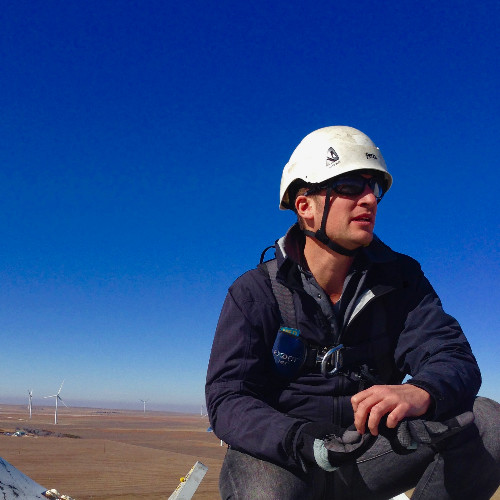
I’m a Senior Research Engineer at the National Laboratory of the Rockies (NLR, formerly NREL), where I lead research at the intersection of wind energy, turbulence fluid physics, and applied mathematics. My work focuses on understanding wind turbine wake dynamics, developing advanced sensing technologies, and creating computational models that bridge fundamental fluid mechanics and practical engineering applications. I have codirected a $65M+ research portfolio spanning large-scale field campaigns, instrumentation development, and reduced order modeling.
Research Focus
My research centers on fundamental questions about how wind turbines interact with the atmosphere and each other. Working with multi-institutional teams across national labs, universities, and industry, I’ve designed field experiments, developed measurement technologies, and built models that advance wind energy science and deployment.
Wind Turbine Wake Physics: As Principal Investigator for the Rotor Aerodynamics, Aeroelastics, and Wake (RAAW) experiment ($8M+) and Co-Investigator for the American WAKE experimeNt (AWAKEN, $28M+), I’ve led field campaigns investigating how wind turbine wakes evolve, interact, and dissipate considering the atmospheric boundary layer as a dynamic forcing environment. These experiments have produced 200+ TB of validation-quality data now used internationally for model development and uncertainty quantification.
The goal is straightforward: better predictions of wind plant performance and turbine loads.
Remote Sensing & Instrumentation: I’ve developed acoustic tomography systems that reconstruct three-dimensional turbulent atmospheric wind and temperature fields from sound propagation measurements. This approach provides volumetric flow characterization with higher spatial and temporal resolution than conventional point measurements or line-of-sight remote sensing, revealing turbulent structures that are difficult to capture with traditional instruments.
Reduced-Order Modeling & Physics-Informed Machine Learning: Much of my work focuses on developing computationally efficient models of coupled dynamical systems. Using modal decompositions and physics-informed machine learning, we create models that capture essential structural, controller, and wake dynamics while remaining tractable for design optimization and real-time control applications. The goal is to retain the physics that matters while achieving computational speedups of 100-1000x over traditional CFD.
Data Assimilation & Digital Twins: In the Floating Offshore Wind Modeling and Simulation (FLOWMAS) Energy Earthshot Research Center ($19M DOE Office of Science, 2020-2025), I led the data assimilation and digital twin development. This work focused on integrating observational data with multiscale simulations spanning global climate models (E3SM), mesoscale atmospheric models (ERF), and microscale wind turbine simulations (ExaWind). I developed variational data assimilation methods (4D-Var), ensemble Kalman filtering approaches, and physics-informed machine learning techniques for state estimation in coupled metocean-turbine systems. The digital twin framework incorporated measurement system design, adaptive control architectures, and uncertainty quantification across the full simulation stack. The project was shuttered in 2025 due to federal reorganization of DOE EERE.
Background
I earned my Ph.D. in Mechanical Engineering from Portland State University, where I developed methodological advances in nested modal decomposition strategies for describing the spatial evolution of wake modes and reduced-order modeling of dynamical systems. My dissertation focused on wake character in wind turbine arrays, examining the organization, spatial evolution, and dynamic behavior of turbulent flows in renewable energy systems.
I currently live in Corvallis, Oregon with my family, where we moved in 2024 to build community and be closer to family. As Oregon natives, we’re invested in contributing to the state’s research enterprise and coastal communities while advancing renewable energy science.
Research Impact
My research has produced benchmark datasets and validation frameworks now used internationally by academic, national laboratory, and industry research teams. I’ve published 90+ peer-reviewed articles (1,200+ citations, h-index: 21) and serve as Associate Editor for the Journal of Renewable and Sustainable Energy. Through the IEA Wind Technology Collaboration Programme with researchers across 10+ countries, I’ve contributed to advancements in aerodynamics, remote sensing, wake modeling, and instrumentation development.
The AWAKEN and RAAW field campaigns have become reference datasets for computational model validation, providing the high-quality measurements needed to improve wake models, turbine design tools, and wind plant optimization strategies.
Strategic Coordination
Effective research requires coordination that amplifies individual investigator impact while elevating institutional mission spaces. Through managing concurrent projects spanning fundamental science, applied engineering, and infrastructure modernization, I’ve developed expertise in distributed leadership models where working groups maintain decision authority, pre-deployment workshops establish priorities before conflicts emerge, and regular synthesis enables cross-institutional review. This approach has proven successful in coordinating heterogeneous sensor networks, diverse stakeholder expectations, and competing facility demands across multi-institutional collaborations. Alongside infrastructure modernization at world-class R&D facilities and remote sensing innovation. This work requires balancing competing priorities while maintaining federal relationships across DOE offices, NSF, NASA, and NOAA.
Mentoring and Leadership
I am committed to developing the next generation of renewable energy researchers through sustained mentoring relationships. I have supervised 12 graduate students, 4 postdoctoral researchers, 20+ undergraduate researchers, and 11 junior staff, leading to more than 20 peer-reviewed publications with mentees as lead authors. My three NREL Outstanding Mentor Awards (2018, 2020, 2023) reflect sustained success supporting diverse students from undergraduate interns to postdoctoral researchers. Several mentees now hold faculty positions, lead research programs at national laboratories, and occupy senior technical roles in the wind energy industry.
Recognition
- NREL President’s Award (2022) for outstanding achievement in field campaign planning and execution (AWAKEN & RAAW)
- NREL Outstanding Mentor Award (2018, 2020, 2023)
- Scientific Committee Lead, North American Wind Energy Academy (NAWEA) 2026 Conference
- Research Board Member, TWAIN Project (The Wind energy science, technology, And Innovation Network)
- NASA Scientific SME, Multi-Sensor Worldwide Ocean Winds (MWOW) Data Product Development
For inquiries about research collaborations, field campaign data access, or student opportunities, please contact me at nicholas.hamilton@nlr.gov.